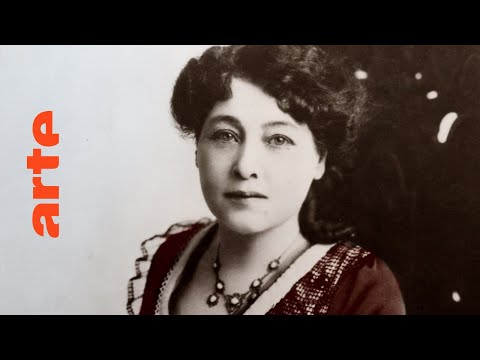
Rediscovering Alice Guy: A Night of Cinema, Music, and Memory
04/07/2026
Saturday, May 30, 2025 – La Cinémathèque Française, Paris
There are nights that feel like something magical happens. Quietly, without fuss, without grand pronouncements — and yet important. That Saturday night at La Cinémathèque Française was one of those nights.
As part of the third Festival des femmes (pas) oubliées — "The Festival of Women (Not) Forgotten" — a cine-concert was held in tribute to one of cinema's great pioneers: Alice Guy. You've probably never heard of her. And that's kind of the point.
But if you care about film, history, or the stories we choose to remember, you should.
Who Was Alice Guy?
Alice Guy was the world's first female filmmaker, and one of the very first filmmakers, full stop. She made her first film in 1896, just a year after the Lumière brothers' first public screening. Like Georges Méliès, she saw that film could be more than just a novelty — it could be a medium for storytelling, emotion, imagination.
She began as Léon Gaumont's secretary, but quickly proved herself a visionary. Her first film, La Fée aux Choux (The Cabbage Fairy), was a success — and from there, she directed, produced, or supervised over 700 films, eventually founding her own production company in the United States.
She was a contemporary of the biggest names in early cinema — and yet her name has largely disappeared from the canon.
Why? The usual reasons. She was a woman. Her career ended with her divorce. Her legacy was buried under others' names. And by the time she tried to retrieve her own history, most of her work had been lost or misattributed.
A Night of Revival
That's what made Saturday night so moving.
Inside the Grande Salle Henri Langlois — my pick for the best cinema room in the world — the audience was treated to eight of Alice Guy's surviving films. Some were comic, some poetic, some playfully feminist. All of them bore her unmistakable touch: curiosity, precision, and heart.
Yes, you can watch some of these films online. But there's something about seeing them projected, in silence but for the breath of the crowd and the live music, that brings them to life again — not just as relics, but as cinema.
And this wasn't just a screening. It was a full cine-concert, featuring new musical scores composed by Céline Fankhauser, performed live by La Symphonie de Poche and the Duo Circé (with the additions of Amelia Feuer as soprano and Clémentine Dubost on piano).
The music wasn't archival; it was alive — weaving between period authenticity and modern interpretation. At times melancholic, at times raucous and jazz-inflected, it added dimension, drama, tenderness. In one piece, the words of poet Milène Tournier were set to music and sung aloud — contemporary voices literally in conversation with Alice Guy's silent frames.
It was more than performance. It was dialogue across time.
Why This Matters
There is a unique kind of grief in realising how many voices we've lost to history — not because they didn't speak, but because no one bothered to listen.
Alice Guy was there. She shaped the medium. She made us laugh and feel. But until very recently, she was relegated to a footnote, if mentioned at all.
The problem isn't just exclusion from power. It's exclusion from memory.
When we believe that women — or other marginalised people — weren't there, it often isn't because they didn't contribute. It's because they weren't recorded. Or they were erased. Or their work was credited to someone else.
Events like this aren't just tributes. They're acts of historical repair. They restore dignity. They invite us to reconsider what — and who — we think of as central.
They also raise uncomfortable questions.
Reflect and Connect
Who are the forgotten women in your cultural history?
Who are the women — in your family, your country, your field — whose stories deserve to be told?
Where might you look to rediscover them?
And beyond that: what can you do to listen more deeply today?
This isn't just about cinema. It's about visibility. Legacy. Whose stories are preserved, and whose are left to decay.
If you've ever felt overlooked, misremembered, or pushed to the margins, there is something cathartic about seeing someone like Alice Guy finally honoured — on the big screen, before a full house, with music swelling all around.
And perhaps the most moving part of the night was this: it was women doing the honouring. Women composing, directing, performing. Women lifting up the work of another, across a gap of more than a hundred years.
It felt like witnessing a lineage being restored.
Go Deeper
If you're curious, here are a few ways to connect further:
Watch the documentary Be Natural: The Untold Story of Alice Guy-Blaché (directed by Pamela B. Green, narrated by Jodie Foster).
Explore the work of Les Inoubliables, the collective behind the festival, which promotes female voices in composition and performance.
Seek out Alice Guy's surviving films online. Start with Falling Leaves (1912) or Le Matelas Épileptique (1906).
Reflect on who shaped your creative lineage. Whose work helped form you, even if you didn't see them on the main stage?
Sometimes, honouring the past is how we start to shape a better future.
And sometimes, it starts with a woman, a camera, and a cabbage fairy.

Can you feel it? A little more light at the end of each day. The first blossoms on the trees. An unmistakable sense of movement in the air. Winter is ending, and spring is just around the corner.

You're the calm one. The rock. The person your friends and partners value because you're chill, easy to get along with, and "no drama." You rarely, if ever, get angry.